Do Models Like Medical Puzzles?
Working research notes. Scope, datasets, and the puzzle taxonomy are still moving.
Hypothesis
Contrastive evaluation tasks modeled on categorical word puzzles can serve as both a probe and a training signal for relational and ontological structure in domain-specific embedding spaces.
We are seeking for models to "go beyond" co-occurrence and push the models to align their framing space to more latent concepts.
Motivation
To create better concept-aware domain-specific embeddings that go beyond semantic or contextual embedding, and instead cluster in a sort of "domain specific" latent space to improve reasoning and understanding.
Approach
The standard template for this is: "We introduce [evaluation framework], then show that using it as a training signal improves [downstream tasks]." This is a well-established paper structure. You see it in SapBERT, SentEval, and many probing-task papers that later demonstrate the probes can be repurposed as auxiliary objectives.
The natural flow would be:
- Define the Connections-style evaluation taxonomy over our relation types.
- Show that existing medical embeddings fail at it in interesting ways (the diagnostic contribution).
- Use the puzzle tasks as contrastive or auxiliary training objectives.
- Show improved performance on both our evaluation and established benchmarks like MedNLI, MedSTS, or entity linking tasks.
Puzzle Taxonomy
The starting point is the categorization used for NYT Connections puzzles, which splits groupings by word form, word meaning, or both.
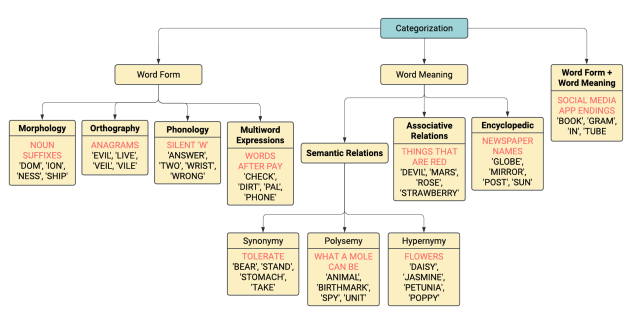
Taxonomy figure from Samdarshi et al., EMNLP 2024.
Extensions to the Medical Terminology Domain
For tasks in the Semantic Relations section we also want to explore the relationships built on phrases as well. So beyond just the structure of words, we want to discover associations between medical texts.
Each category below lists a definition, an example grouping, and how we plan to generate puzzles for it.
Word Form
Morphology
The subfield of linguistics that studies the internal structure of words, analyzing how they are formed from smaller, meaningful units called morphemes. It examines rules for creating new words (derivation) and altering word forms (inflection) based on grammatical contexts.
- Example, "Derm-": dermatology, dermatitis, dermatosis, dermis
- Generation: direct regex on Greek and Latin roots, using the list of medical roots and affixes.
Multiword Expressions
- Example, "Words after Acute": acute inferior myocardial infarction, acute anterior myocardial infarction, acute ST-elevation myocardial infarction, acute non-ST-elevation myocardial infarction
- Generation: pattern-recognition steps plus similarity tagging on common words seen in the SPECIALIST dataset.
- References: linguistic approach to multiword technical terms, SPECIALIST distilled n-grams
Semantic Relations
Synonymy
Different surface forms that refer to the same concept.
- Example, "Fainting synonyms": syncope, vasovagal syncope, light-headedness / blackout
- Example, "White blood cells": leukocytes, leucocytes, WBC
- Generation: an LLM rewriter (for phrases), parsing text for "also known as", and parsing the "Other names" field of articles. The CDC Plain Language Thesaurus for Health Communication (used by EMERSE) is another source.
Polysemy
In medical terminology, polysemy occurs when one symptom term represents multiple related, yet distinct, concepts. A key example is "inflammation", which acts as a polysemous term by simultaneously referring to a biological process (e.g., "The inflammation is spreading") and an anatomical outcome/localized area (e.g., "The inflammation is 5 cm" or "The inflammation is on the arm") (reference).
- Example, "Edema": "the process of fluid accumulation", "the symptom of physical swelling"
- Generation: UMLS.
Hypernymy
In medical terminology, a hypernym is a broad term (a superordinate) that covers a general category of symptoms, while the specific, individual symptoms under that category are the hyponyms.
- Example, "Headache": migraine, tension headache, cluster headache
- Generation: per Wikipedia article, parsing the "Types" section. See also Biomedical Concept Normalization by Leveraging Hypernyms.
Word Meaning
Associative Relations
Prior work has studied models of automatic priming for word identification that are typically divided into groups based on associative relations (e.g., spreading activation) and others based on semantic similarity (e.g., distributed models).
- Example, "Drugs associated with resolving mental illnesses": antidepressants, anti-anxiety drugs, antipsychotics, mood stabilizers, stimulants
- Example, "Series of steps to discern between flu and the common cold": phrase 1, phrase 2, phrase 3, etc.
- Generation: TBD.
Encyclopedic
We notice that to group certain sets of words into their proper categories, one needs knowledge that spans beyond concepts and relies on entities in the real world found in knowledge bases such as Wikipedia.
- Example, "Names of prominent alternative medicine personalities in the 2000s": Weil, Chopra, Oz, Hyman
QA Task
Given an unfinished set of knowledge, which is the most likely to correspond to the input.
- Example, "Medical report of a patient suffering from unknown heart issues": report section A, result B, report C, D
Data
Sources
- MalaCards: disorders and illnesses
- Wikipedia Glossary of Medicine: terminologies
- UW Biology course catalog: for hierarchical clustering
Preprocessing
NER as a preprocessing step.
New Puzzle Formulations
Don't try to build all of them at once. Stagger them:
- First: clean up the existing associative SemMedDB puzzles (the contamination fixes from the last round). Get RLVR working on those. This proves the methodology.
- Second (next milestone): patient co-occurrence puzzles from PMC case reports. Largest scale of the three new families, most amenable to automated construction, complementary signal to SemMedDB.
- Third (paper extension): mechanistic chain puzzles. Smaller scale, higher quality, hardest to construct, but the most distinctive contribution.
- Fourth (if time): differential diagnosis puzzles from MedQA distractors.
Each stage gives a complete result that could be written up. If we only get to (2), that is a solid contribution. If we get to (3), it is a paper that genuinely opens a new direction in biomedical reasoning evaluation.
Two Cautions
Concept extraction quality matters a lot. The patient co-occurrence and mechanistic chain families both depend on automated concept extraction (scispaCy + UMLS linker, or MedCAT). These tools are decent but not perfect. Garbage extraction produces garbage puzzles. Plan to spend real time validating the extracted concepts before puzzle construction. A small hand-validation step on 200 randomly sampled puzzles will tell us whether the extraction pipeline is good enough.
LLM-assisted construction is fine but verify. For mechanistic chain puzzles especially, we'll want LLM help to extract chains from review articles. That's legitimate, but every puzzle that goes into evaluation needs human verification. Reviewers will (correctly) ask "how do you know the puzzle is solvable and the ground truth is right?" Hand-verified eval sets and LLM-constructed train sets is a defensible split, but the evaluation set must be clean.
Why This Matters
The path from the current results to a publishable paper goes through these new puzzle families. The associative SemMedDB results already show the methodology works and that frontier models fail on the right axis. Adding clinically-grounded and mechanistically-grounded puzzles makes the contribution about biomedical relational reasoning broadly rather than one specific KG-derived task, which is a much stronger framing for a venue like ACL or EMNLP.
References
- HILL: Hierarchy-aware Information Lossless Contrastive Learning
- NYT-Connections: A Deceptively Simple Text Classification Task that Stumps System-1 Thinkers (COLING 2025)
- Connecting the Dots: Evaluating Abstract Reasoning Capabilities of LLMs Using the New York Times Connections Word Game (EMNLP 2024)
- Biomedical Concept Normalization by Leveraging Hypernyms (EMNLP 2021)